There is a chance for workers to be injured while on the job, and workplace absenteeism due to worker illness or injury contributes to overall productivity (Jinnett et al., 2017). Injuries at work have been shown to cost approximately 11 lost workdays (Peterson et al., 2021), losing thousands of dollars of work value per injury. In 2022, the U.S. Bureau of Labor Statistics reported 2.8 million nonfatal workplace injuries and illnesses in the United States, which comprises an injury rate of 2.7% of workers (U.S. Bureau of Labor Statistics, 2023). Due to either the injury itself or the workers’ compensation process, a workplace injury claim can last a few months (Smith & Anderson, 2017) or years (Sears et al., 2021). Sometimes, an injured worker may never return to paid employment (MacEachen et al., 2010).
Transitioning into vocational retraining or returning to work can be difficult for some injured workers. There is no universally accepted role or term for the return-to-work coordinator (MacEachen et al., 2020), and workers who can create their vocational retraining plan rarely follow up after committing to their retraining (Sears et al., 2015). Workers also risk being placed into training or jobs that may not align with their vocational goals. A common suggestion for improving workers’ compensation is having more input in developing the vocational retraining plan (Sears et al., 2014a; Wagner et al., 2011).
This study examines the differences in motivation to continue or seek paid employment, overall life well-being, and salary between injured workers who completed vocational retraining for a job aligned with their work interest, compared to injured workers who did not align with their desired and actual retraining plan. Providing vocational retraining for injured workers, especially early on, is critical for their chances of returning to work (McLennan & Ludvik, 2021). The goal of this study was to influence the best practice of vocational rehabilitation counselors by showing the significance (or lack thereof) of placing a worker eligible for vocational retraining into a program that meets the client’s job goals and interests.
Research Questions
The first research question asked, “How does placing injured workers in retraining programs that align with their vocational interests affect their motivation regarding work?” The next objective of this study was to see the relationship between vocational retraining program placement alignment with career interests and career earnings for the worker in their post-injury and post-vocational retraining employment. The relevant research question asks, “What is the relationship between the alignment of vocational retraining interests and career earnings?” The final objective of this study was to examine the relationship between vocational retraining interest alignment and participant well-being. The third research question asks, “What is the relationship between the alignment of vocational retraining interests and well-being?”
Significance of the Study
There is little research on the effect of vocational retraining alignment on injured workers’ motivation, mental health, and financial situation. Being at a new job post-return to work is considered an understudied phenomenon (Figueredo et al., 2020). Many studies regarding return-to-work (RTW) for injured workers have focused on the employment status post-injury or the time between injury and RTW (Young, 2009). Sears and her colleagues (2013) studied injured workers’ satisfaction levels with the vocational rehabilitation process in Washington State before and after they closed their claims, as well as recorded suggestions for the vocational retraining process from the injured workers themselves, with one-fourth of the suggestions asking for more input from the client towards their vocational retraining plan. These findings indicate that there may be a lack of client voice in the vocational retraining planning portion of vocational retraining, which could lead to the worker losing their autonomy in the matter, affecting their motivation. Another study showed that 41% of participants were “somewhat satisfied” or less with their vocational rehabilitation counselors’ understanding of their employment interests (Ipsen & Goe, 2016), indicating that many clients are not fully satisfied with their vocational retraining process due to a lack of understanding of the injured worker’s vocational retraining goals.
Wagner et al. (2011) concluded a similar study, recording the experiences of injured workers who underwent vocational retraining and collecting suggestions for the vocational retraining process in British Columbia, Canada. Härkäpää et al. (2014) explored the relationship between the motivations for a worker to participate in vocational retraining and their life circumstances. Having autonomy in a person’s work decisions is important for overall well-being. A meta-analysis of 20 articles showed that autonomy at work positively affects a worker’s well-being (Figueredo et al., 2020). These studies suggest that workers desire autonomy within their vocational retraining plans, which are not always being met.
This study hypothesizes that to provide a better chance at thriving and positive well-being, the vocational interests of the injured worker must be considered and met; failure to do so could result in dissatisfaction in vocational rehabilitation services, leading to a potential early exit from the program (Ipsen & Goe, 2016). Even with options for the client to create their plan, retraining funds from the self-created plan are often not used (Sears et al., 2015). The results and interpretation of this study may guide vocational rehabilitation counselors in their practice of vocational retraining and job placement for injured workers who must begin a new career after an injury.
Review of the Literature
Vocational rehabilitation aims to quickly return injured workers to the workforce to the best pre-injury salary possible (U.S. Department of Labor, n.d.). This can be done by helping the injured worker overcome obstacles to RTW with interventions such as a vocational retraining plan with a new career goal (Sears et al., 2021). Those with education levels of high school or below have been shown to have unfavorable long-term outcomes in returning to work (El Moheb et al., 2022; Herrera-Escobar et al., 2019). With many people participating in dangerous jobs having a below-high school education (Butler et al., 1995), vocational rehabilitation must be created to allow injured workers to participate in planning thoroughly and completing their vocational retraining. Since the creation of workers’ compensation over 100 years ago, many amendments to vocational rehabilitation have made this retraining possible. Nevertheless, there is still room for improvement within the system (Sears et al., 2014b).
Theory of Work Adjustment
People have many environments that they must interact with, such as home, school, and work (Dawis & Lofquist, 1984). With each of these environments, the person interacts with the environment, and the environment interacts with the person. In vocational psychology, Dawis and Lofquist’s (1984) Theory of Work Adjustment (TWA) describes how a worker and work environment have a relationship that benefits both parties. The original intention of the theory was to help vocational rehabilitation clients adapt to issues they may be facing at work due to an injury, accident, or illness. The Theory of Work Adjustment proposes that worker tenure increases when job satisfaction is achieved by working in a work environment they can relate to through their skills, abilities, and values (Dawis & Lofquist, 1984). Dissatisfied workers have the possibility of experiencing depression (Stice & Dik, 2009). Dawis and Lofquist (1984) have identified 17 formal propositions relevant to TWA.
The relevance of this theory to workers’ compensation and vocational retraining pertains to the careers that injured workers will need to train in. Similar to how us humans have physiological needs such as water, air, and food; we also have the psychological needs of having relationship in where they work that agrees with them. A worker who can no longer do a physical, hands-on job may feel displaced if retrained into a sedentary job. The job does not meet their values or psychological needs. An analysis showed that vocational retraining clients were often placed in unskilled jobs that provided the workers with lower wages and fewer career advancement opportunities (Martin et al., 2012). In turn, the worker is less likely to perform at satisfactory levels.
Self-Determination Theory
Richard Ryan and Edward Deci’s Self-Determination Theory (SDT) is a theory that focuses on the psychological level of human thriving or thwarting (Ryan & Deci, 2017). Like humans’ physiological needs, such as water, air, and food, humans also have psychological needs crucial to sustaining their well-being: autonomy, competence, and relatedness. Autonomy is the human need to regulate one’s own experience and actions, competence is the human motivation to learn and achieve mastery in performed tasks, and relatedness is the need to feel a sense of belonging and being socially connected to other people.
When these three basic psychological needs are met in vocational retraining, they can be core drivers of participation within vocational retraining, and lead to better return to work outcomes (K. Chen et al., 2025). Likewise, if a vocational retraining program does not meet these needs of autonomy, competence, and relatedness for the injured worker, they are likely to experience frustration, potentially affecting their rehabilitation negatively.
Work and Mental Health
There is a plethora of evidence to suggest that unemployment (or worklessness) has a strong relationship with poorer mental health (Waddell et al., 2006). As such, work can be considered a remedy for the poor health effects of unemployment. When an employee is injured, there is stress from multiple sources of the event and the accompanying consequences. Various studies have shown that there is a correlation between workplace injuries and poor mental health (Leibler et al., 2017), such as PTSD and depression (Lin et al., 2014). It is not just a single aspect of an occupational injury that creates stress for an employee but a culmination of all aspects revolving around the event. These stressors could make it difficult for an adult learner to participate and succeed in vocational retraining, as chronic stress can diminish the quality of learning and memory (S. H. A. Chen & Goodwill, 2022). Workers who have experienced an industrial career-changing workplace injury are presented various stressful situations conducive to worse mental health states. These include the injury itself (Wiseman et al., 2013), the workers’ compensation process (Wightman et al., 2025), and reduced income from workers’ compensation benefits (Smith & Anderson, 2017). These multiple stressors make vocational rehabilitation more complex due to worsening learning and memory caused by the stress. The unemployment that comes, as a result, can be detrimental to a person’s mental health (Paul & Moser, 2009). To properly rehabilitate workers in a new career, navigating through the variety of distress they are experiencing is crucial to ensure success (Collie et al., 2020).
The American Psychological Association’s (APA) yearly Stress in America Survey finds money is a common source of stress among most American adults (Anderson et al., 2016; Weinberger et al., 2018). Households with an annual income of below $20,000 report the highest level of depression when compared to other household income brackets below income (Weinberger et al., 2018). Finances play a critical part in a person’s mental health. Workers who depend on workers’ compensation as their only source of income following a workplace injury tend to have more financial stress when compared to workers who are still receiving their workplace income (Sheehan et al., 2020). As injured workers begin to use their savings and feel the financial burden of a reduced wage, they could face financial deprivation. Frasquilho et al. (2016) showed that unemployed participants were likely to report higher levels of financial stress. This finding is consistent with findings from another study (Collie et al., 2020), which found that 30% of workers with MDSs or a mental health condition reported experiencing high levels of financial stress. Financial stress can interfere with one’s ability to participate in a vocational rehabilitation program fully; Siggeirsdottir and colleagues (2016) showed that a participant’s supplemental income was the most critical factor in predicting success in a vocational rehabilitation program. This supports the notion that financial strain creates a barrier to returning to work (Voss et al., 2019).
Methods
Participants
To determine the frequency and intensity of vocational training alignment and long-term worker well-being, data was gathered from those who had participated in the vocational retraining process in any capacity, regardless of completion status. As such, participants who completed the survey had to participate in vocational retraining due to a career-ending industrial injury in any capacity, thus requiring the worker to retrain into a new career through Washington State Labor and Industries.
To have been eligible for this study, participants must have participated in vocational retraining in any capacity within the last 10 years (from January 16, 2016, to January 16, 2026) through a vocational retraining plan approved by Washington State Labor and Industries (either Option 1 or Option 2). Participants were recruited from four local legal firms who specialize in workers’ compensation and vocational retraining. The researcher had met with a partner from each firm to detail the study. Each firm agreed to send survey links to clients to complete the survey online. The firms emailed all their vocational retraining clients to ask them to participate in the survey. Email recipients were given a link to an online survey. Due to the surveys being anonymous, it was not possible to identify which surveys came from each law firm. Participants were ensured that no one, even the researcher, would be able to identify who participated in the survey. As such, the surveys had no impact on the participants’ workers’ compensation claims. The non-probability sampling methods used included purposeful and convenience sampling. These methods of sampling were selected for a variety of reasons. Participants had participated in vocational retraining, aligning with the purposeful sampling method (Merriam & Tisdell, 2015). However, the convenience sampling method is partly due to the client being chosen from local vocational rehabilitation law firms, thus excluding workers in other areas of the state and country.
Instrumentation
The questionnaire was created by combining the Situational Motivation Scale (SIMS) and the World Health Organization-Five Well-Being Index (WHO-5), and questions regarding desired and actual vocational retraining plans, employment status, and salary. Rooted in the self-determination theory, SIMS was created by Guay et al., to measure situational motivation in field and laboratory settings. Motivation in the context of SIMS is defined as the motivation someone feels when engaging in a particular activity (Guay et al., 2000). A Spanish version of SIMS was created and validated by Martín-Albo et al. (2009), and a Spanish translation of the WHO-5 was published online by the World Health Organization. The Spanish version of the survey used for this survey was reviewed by two fluent Spanish speakers and translators for readability and accuracy of questions.
The use of the SIMS scale assisted in answering the first research question. Four types of motivation were measured with the SIMS. The first motivation type is intrinsic, which is the motivation to do an activity for its own sake, such as pleasure or enjoyment. The second item measured with the SIMS is identified regulation, referring to how someone personally identifies with an activity’s values. The third measured variable, external regulation, is when behavior is driven by the desire to obtain rewards or avoid negative consequences. The final type of motivation measured is amotivation, which is a lack of motivation towards a particular activity. This differs from intrinsic motivation, where a task is done for internal satisfaction, but rather the person identifies with the values of an activity. Scoring the SIMS required averaging the scores for each of the four subscales for each type of motivation. Using each subscale as part of a multidimensional scoring method has provided a more accurate and comprehensive representation of motivation (Howard et al., 2020).
This study used Multivariate Analysis of Variance (MANOVA) to analyze the differences between the two groups. MANOVA is a statistical procedure frequently used by psychological researchers (Warne, 2014). As a member of the General Linear Model, the MANOVA procedure is an extension of standard Analysis of Variance (ANOVA). In an ANOVA, an independent, nominal variable with two or more values measured against a single dependent variable with data in an interval or ratio format. The effect size from the ANOVA analysis gives a numerical quantity to the relationship between the two variables. In MANOVA, the independent variable is tested with two or more dependent variables.
Running multiple ANOVAs is not recommended over a MANOVA. While multiple ANOVAs could technically work, there is a higher likelihood of a Type 1 error (Warne, 2014; Zientek & Thompson, 2009), which is caused when the null hypothesis is falsely rejected (Miller, 2017). Given these reasons, it was decided that MANOVA is the best suited analytical test to analyze the data and answer the research questions.
In the study, the independent variable in the MANOVA analysis was the alignment and no alignment groups. The six dependent variables in the data analysis were the four measured types of motivation from the SIMS (intrinsic, identified regulation, external regulation, and amotivation), the well-being score from the WHO-5, and the salary range from the corresponding multiple-choice question. The multiple-choice question for salary had ranges of roughly $10,000 ($10,000 – $19,999, $20,000 – $29,999, and so on) instead of the participant entering their yearly monetary income. This was done to increase the ease of taking the survey and protect participants from having their exact salary traced back to them.
The WHO-5 is one of the most used tools used to measure well-being in participants and helps determine a person’s well-being over a two-week period (Sischka et al., 2020). Developed in the 1990s by Per Bech (World Health Organization, 2024), the WHO-5 was intended for use in primary care, but has since become an accepted instrument used in a variety of general population studies and settings (Iversen et al., 2026). The index consists of five questions with six-point Likert scales, from zero to five. To score the WHO-5, the scores of the five questions were added to gather the raw score (World Health Organization, 2024). Then, the raw score was multiplied by four to get a percentage. Scoring a zero-percentage score would represent the worst well-being, and the max score, one hundred, would represent the best. A score below 50 would represent poor well-being, indicating the possibility of a mental health condition. The percentage score was used for data analysis.
The internal consistency of the SIMS scale has been shown to be acceptable in many studies (AL Muniandy et al., 2023; Guay et al., 2000; Østerlie et al., 2019). A WHO-5 index has been shown to have strong internal consistency, with one study showing to have an alpha range from 0.81 and .90 in three different tests (Lara-Cabrera et al., 2022).
Data Analysis
Quantitative research allows variable data to be collected and analyzed numerically to show trends between independent and dependent variables (Cozby & Bates, 2024). This study is confirmatory, so quantitative data collection and analysis were appropriate methods to test the hypotheses of this study.
Participants who reported engagement in vocational retraining plans that aligned with their job goals were placed into Group 1 for analysis, while those without such alignment were placed into Group 2. Group assignments served as the independent variable in the study. The dependent variables being measured were well-being, motivation to work, and salary.
Statistical Analysis
This study utilized the one-way MANOVA test to analyze the survey responses. The researcher decided to use one-way MANOVA for several reasons. This study measured the difference between multiple dependent variables between the two groups of the single independent variable. For the SIMS, each of the four types of motivation were measured separately, resulting in six overall values being analyzed in the MANOVA. Salary was a separate value for analysis. The well-being scores out of 100 from the WHO-5 were used in the MANOVA analysis. As such, the MANOVA tested the differences in six overall dependent variables between the two groups.
Following the MANOVA analysis, a descriptive discriminant analysis (DDA) was used. This post-hoc analysis is a descriptive or interpretive procedure done after the initial analysis that helps explain the differences between the two groups in a simple way to interpret (Warne, 2014). Using a DDA, the researcher used the collected data to determine what dependent variables contributed to the underlying differences between groups by using a set of uncorrelated linear equations that help demonstrate the differences between groups in the MANOVA (Huberty & Olejnik, 2006; Warne, 2014), which allowed the researcher to see if any dependent variables may explain the differences.
IRB Approval
The university’s Institutional Review Board approved the study on January 8, 2026 (identifying information withheld for blind review). To protect the identity of participants, online submissions were hosted through Qualtrics, which is a secure online platform. The landing page of the survey explained the participant’s role in the study and asked for their consent to participate in the survey before starting. The data was downloaded onto a password-protected computer for analysis that only the principal investigator could access. Participants were not required or prompted to provide any exact identifying information, such as name, and ranges were used for the age and salary question to protect such demographic information.
Data Analysis & Results
Descriptive Statistics
The study included 33 participants. Twenty-eight participants filled out the English version of the survey, and five participants filled out the Spanish translation. Two surveys (one in English and one in Spanish) were not completed in their entirety, making these surveys ineligible for data analysis. A total of 31 surveys were deemed usable for the data analysis portion of this study. A minimum of 250 surveys were distributed to eligible participants, indicating a response rate of about 12.4%. However, the exact number is unknown, as not all participant leads reported how many were distributed. As previously mentioned, the researcher faced some challenges in collecting data for this study.
The age brackets of respondents ranged from 35-44 years old to 65 or older. The most frequent age bracket was 45-54 (n = 11), while the least frequent was 65 or older (n = 2). A majority (64.5%) of respondents were male. Most of the participants had no alignment in vocational retraining (n = 19, 61.3%), but the same number of participants did complete vocational retraining (n = 19, 61.3%). All 12 respondents (100%) who indicated they did not complete vocational retraining also showed they did not have alignment in vocational retraining. Exact participant details were not collected to ensure the anonymity of those who completed the survey.
All but five (n = 26) respondents indicated a desired vocational retraining plan that differed from one another, not repeating in other responses. Three different participants indicated that they wanted to retrain as a “Construction Project Manager” (n = 2) or “Construction Management” (n = 1). Two participants indicated they wanted to retrain into a “teacher” (n = 1) and “pe teacher” [sic] (n = 1), specifically. The most actually realized retraining plan goal was some form of an office clerk (n = 12). These responses included “general office clerk” (n = 4), “receptionist” (n = 3), “office manager” (n = 2), “office clerk” (n = 1), “office worker” (n = 1), and “office assistant” (n = 1). These responses accounted for 38.7% of realized vocational goals. Of these 12 respondents, only one, who had entered “office manager,” had alignment with their desired and actual vocational retraining plan.
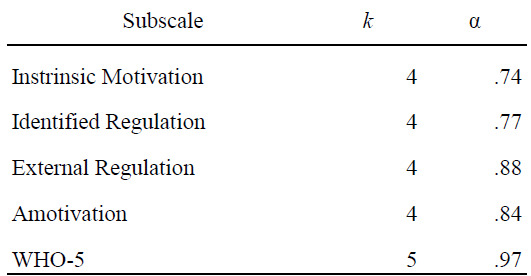
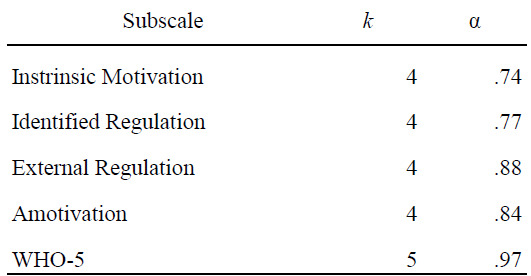
Displayed in Table 1, the intrinsic motivation subscale (α = .74) was found to possess acceptable reliability. The identified regulation subscale (α = .77) was also found to have acceptable reliability. The subscale for external regulation (α = .88) was deemed to have good reliability. The final SIMS subscale measuring amotivation (α = .84) was also found to have good reliability. The WHO-5 scale is used to measure the well-being of the participant during the past two weeks. Consisting of five questions, this scale was shown to have excellent internal reliability (α = .97). All scales used in the survey were found to be above the generally accepted Cronbach’s alpha of .7, indicating that the scale had, at a minimum, acceptable internal reliability in measuring participant motivation and well-being.
MANOVA and DDA Analysis
The output of the MANOVA showed that there was a significant difference between the alignment and the non-alignment groups (Wilks’ Λ = 0.249, F(6,24) = 12.034, p <.001). The descriptive discriminant analysis (DDA) was run through SPSS’s “discriminant” tool. The DDA, with an eigenvalue of 3.008 and a canonical correlation of .866, explains 75% of the variance, significantly separating the alignment and no alignment groups. The Wilks’ Λ for the test for all the dependent variables in the study shows that alignment in vocational retraining is significant (p < 0.001) for the six measured dependent variables.
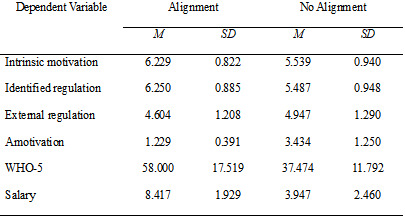
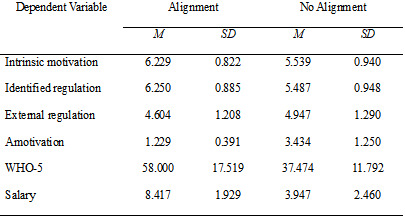
The structure matrix indicates how strong the relationships are between the dependent variables and participant’s vocational retraining alignment. Strong relationships, returning an absolute value of .5 or higher, were amotivation with .632, and salary with - .571. The WHO-5 returned to a moderate relationship with -.419. Identified regulation (-.240) and intrinsic motivation (-.223) were weaker relationships. External regulation (.079) was a negligible relationship of vocational retraining alignment. The results indicate that those with higher levels of amotivation, characterized as the lack of motivation, tend to be in the no alignment group, and those who have higher levels of well-being and reported salaries tend to fall into the alignment group. The results from the structure matrix show that the discriminant function indicates that amotivation, salary, and well-being are the top three strongest separators between the alignment and non-alignment groups. Table 2 shows the descriptive statistics for all measured variables separated by alignment and no alignment groups
Research Question 1 Analysis
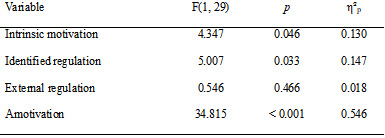
The first research question asked, “How does placing injured workers in retraining programs that align with their vocational interests affect their motivation regarding work?” The main analysis was a Multivariate Analysis of Variance (MANOVA). Table 4 shows the output relevant to the first research question from the MANOVA test run on version 31 of the SPSS software.
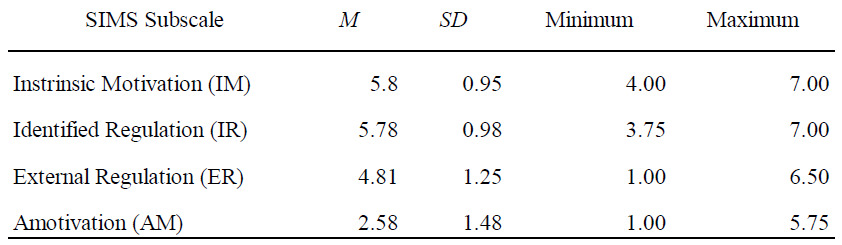
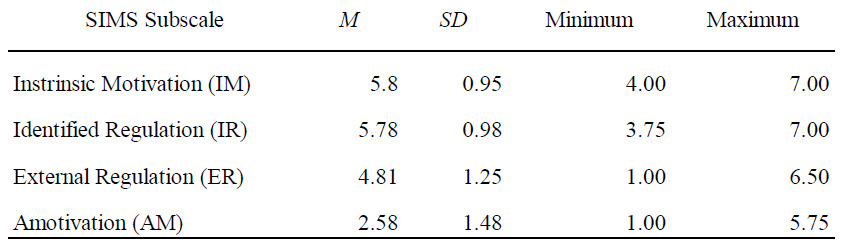
The SIMS scale was used to measure four types of motivation: Intrinsic motivation (IM), identified regulation (IR), external regulation (ER), and amotivation (AM). As shown in Table 3, among all 31 respondents, the average IM score was 5.80 (SD = 0.95), ranging from 4 to 7. The average IR score was 5.78 (SD = 0.98), ranging from 3.75 to 7. The average ER score was 4.81 (SD = 1.25), ranging from 1 to 6.50. The average AM score was 2.58 (SD = 1.48), ranging from 1 to 5.75.
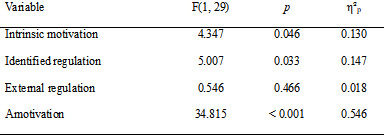
The one-way MANOVA showed that alignment in vocational retraining was significant in intrinsic motivation, F(1,29) = 4.347, p = .046, η2p = .13, identified regulation, F(1,29) = 5.007, p = .033, η2p = .15, and significant in amotivation, F(1,29) = 34.815, p < 0.001, η2p = .546. Alignment in vocational retraining was not significant in reported levels of external regulation, F(1,29) = .55, p = .466, η2p = .02. The participants in the alignment condition had higher levels of IM (M = 6.229, SE = .259) and IR (M = 6.25, SE = .267) than those in the no alignment condition (M = 5.539, SE = .206; M = 5.487, SE = .212), respectively. The participants in the no-alignment condition had higher reported levels of ER (M = 4.947, SE = .364) and AM (M = 3.434, SE = .206). Generally, partial eta squared (η2p ) effect sizes of small, medium, and large are accepted at .01, .06, and .14, respectively (Huck, 2012). Intrinsic motivation has a medium, near large effect size, identified regulation has a large effect size, amotivation has a large effect size, and external regulation has a small effect size.
Research Question 2 Analysis
The second research question of this study compares the salaries of participants who did and did not have alignment in their vocational retraining. Salaries were self-reported using intervals, with each salary bracket increasing in value of approximately $10,000. The analysis shows that the alignment condition was significant in reported salaries, F(1, 29) = 28.43, p <.001, η2p = .5. The partial eta squared returns a value much greater than the generally accepted large effect size of .14, indicating a significantly large effect size. The alignment condition participants reported a higher average salary (M = 8.42, SE = .66) than those who did not have alignment (M = 3.95, SE = .52). Converting the values to assigned salary brackets, the average reported range for those with alignment was between $70,000 and $79,999. In comparison, those without alignment reported an average within the $20,000 and $29,999 range. Employment status may have influence on participants’ responses to this question.
Research Question 3 Analysis
The means of the alignment group were about two or more points larger than the non-alignment group. The combined WHO-5 scores from both groups ranged from four to 72 (SD = 17.3), with a mean combined score of 45.42. The analysis indicates that the alignment condition was significant in reported WHO-5 scores, F(1, 29) = 15.29, p <.001, η2p = .35. The self-reported well-being scores would be considered to have a large effect size, indicating that vocational alignment has a significant effect on an injured worker’s well-being. Those who had alignment in their vocational retraining reported higher scores (M = 58, SE = 4.11) than those who did not have alignment (M = 37.47, SE = 3.27).
Discussion
Implications of the Findings
These findings have many implications on how vocational retraining has an impact in injured worker’s motivation, well-being, and salary post workplace injury, and how adult education should be designed. The results suggest that alignment in vocational retraining can be a significant determining factor in if the injured worker is able to thrive in a new career post injury or not. We, as humans, have an innate desire to work due to the hidden benefits it brings us. We need to have a voice in the work we do, a concept that aligns with self-determination theory and andragogy. We also need to find work that aligns with our requirements for work as explained in the theory of work adjustment.
When injured workers, already experiencing stress from their injury and work displacement, cannot participate in a vocational retraining plan that aligns with their goals and interests, the data suggests they are on track to not only struggle finding paid employment, but also experience the negative consequences due to the lack of employment. The reported monetary earnings between those who are working and those who are not is significant; therefore, it is critical to help injured workers to advocate for a retraining plan that has the best chance to returning them to work, so that they are less likely to face the financial strain of having a reduced, sometimes severely reduced, yearly income.
Suggestions for Practice
This study supports the suggestion that vocational rehabilitations should ensure the injured worker has alignment between their goals and vocational retraining plan. Workers have expressed that their voices have not been heard during the vocational retraining planning process (Sears et al., 2014a), which can be seen as a pattern in the data of this study, as indicated by the percentage of participants who were not aligned in the vocational retraining plan. In the vocational retraining process, guidance on what retraining plan would align with the injured worker’s goals and interests is critical. The client should be given the opportunity to provide input on what their career goals and interests are before a final retraining plan is made. Vocational rehabilitation counselors should work to ensure that alignment exists between the injured worker’s goals and their retraining plan. Data collected from the survey shows that a majority of injured workers who are placed into vocational retraining plans are not participating in vocational retraining plans that align with their career goals or interests. This discrepancy indicates that many vocational rehabilitation counselors are not providing the guidance needed for the individual to create and participate in a retraining plan that aligns with their future career interests and goals. Based on the data showing that roughly 38% of injured workers participated in an officer worker retraining program, the results show that many injured workers are being placed into a general “office worker” retraining program. Only one participant who actually retrained in an officer worker program had alignment, indicating that that career path may be used as a catch-all or default selection for injured workers. Placing an injured worker into a plan that retrains them into a general office worker against their vocational retraining goals does not set the injured worker up for a new career that will allow them to thrive mentally and financially if a general officer worker is not their career goal.
Limitations
There were limitations that impacted the full scope and possibility of the research. One limitation that must be addressed was the sample size. The power analysis had suggested 74 participants take part in the study, while the actual number of participants was 31, roughly 42% of the recommended sample size. Despite this, the overall MANOVA analysis yielded significant results, with Wilks’ Lambda returning a p-value below 0.001 for all tests, and most of the tests returning significant p-values from the MANOVA analysis. Additionally, the partial eta-squared values indicate medium to large effect sizes (excluding external regulation, which was not significant and had a small effect size). Despite these conditions regarding the p-values and partial eta-squared values, caution must be taken when generalizing these results due to the small sample size. Should this study be replicated, more participants would help generate more accurate results.
An unanticipated challenge of this study was gathering survey results from participants. Our original study criteria consisted of individuals who had completed vocational retraining and were employed. This led to only a single response to the original survey. The previous scales measured motivation and well-being at work and required the participant to possess a paid job. New scales were chosen to allow the same motivation and well-being data to be collected without requiring the participant to currently be in a paid employment position.
Future Research
Further study in this subject is warranted to understand what role alignment between worker interests and vocational retraining plays in an injured workers’ motivation to find or keep employment, worker well-being, and actual earned income. A suggested study would include a qualitative study to explore the experiences of navigating the vocational retraining system for those with alignment when compared to those without. A longitudinal study following workers over the span of five or more years to see the outcomes of alignment in vocational retraining should also be considered for future study. The WHO-5 asked participants to report their feelings over the previous two weeks. Following a cohort of both aligned and not aligned participants could allow the monitoring of changes in motivation, salary, and well-being over a longer period. A longitudinal study could also introduce new dependent variables that could be tracked, such as number of hours worked, lengths of held jobs, and other additional health issues that may arise post vocational retraining.
Conclusion
Following a workplace injury, many workers are placed into vocational retraining, typically with the assistance of a vocational rehabilitation counselor. This study is significant as it shows the discrepancy between injured workers participating in vocational retraining plan that aligns with their goals and interests and those who are not. The study also shows the difference in motivation to find or keep employment, the income, and overall well-being between the two groups. When creating retraining plans, vocational rehabilitation counselors should ensure that their client’s job interests are being met as closely as possible, and the client has the knowledge and guidance needed to put an appropriate vocational retraining plan in place.